From almost any vantage point on Santorini, the island looks timeless: whitewashed villages ring the caldera, basket-trained vines pepper volcanic terraces, and tasting rooms buzz with thirsty visitors. Wine has been made here for thousands of years, yet what is unfolding now is close to an extinction-level event for one of Greece’s most important wine regions.
Historic estimates suggest that Santorini once had 3,000-4,000ha under vine. Today, around 1,000ha remains, much of it fragmented into small family holdings. Over the last three vintages, drought and heat have pushed production to record lows. At the same time, the island’s success as a tourist destination has driven demand for hotels and villas on former vineyard land. Greece’s most famous wine export – Santorini Assyrtiko – is being squeezed by its most famous tourism export: Santorini itself.
Centuries-old vineyards in a new climate
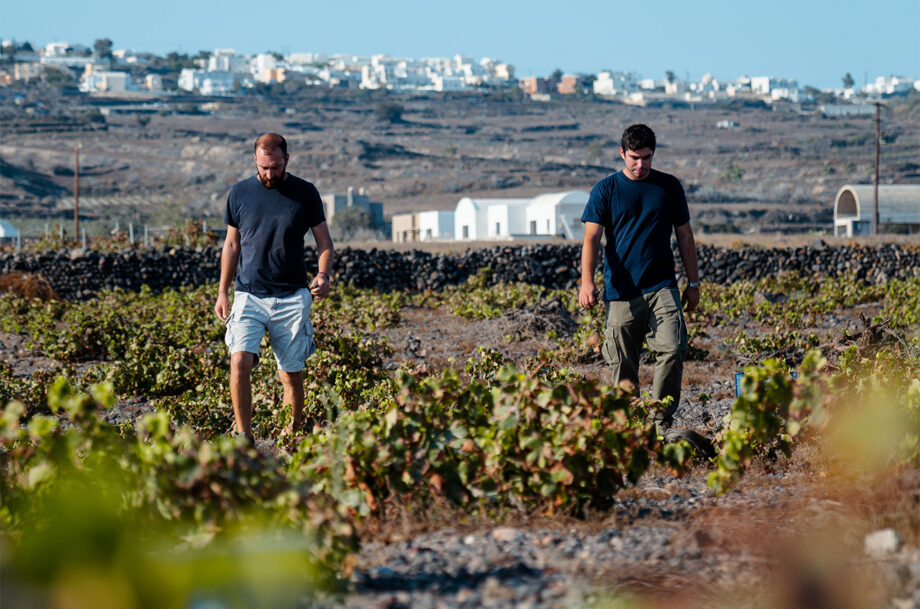
Santorini’s vineyards, largely planted on their own roots in volcanic, sandy soils, form one of Europe’s most historic wine landscapes. Saline, acid-driven Assyrtiko dominates, with Aidani and Athiri playing supporting roles. Vinsanto, made from sun-dried grapes and extended barrel ageing, has been the island’s signature sweet wine for generations. Weaving vines into a basket shape, known as the kouloura, evolved to protect grapes from the Meltemi winds and trap night-time humidity in an already dry climate. Many vineyards are decades if not centuries old.
However, recent work by Greek researchers confirms an alarming trend observed on the ground: the island is seeing less effective rainfall, higher temperatures, lower humidity and increased drought stress each year. As a result, harvests have crept forward into late July and early August.
A visit to Estate Argyros, a modern facility with expansive terraces and interior tasting rooms, wouldn’t indicate anything amiss. Yet owner and fourth-generation winemaker Matthaios Argyros reports three consecutive years of severe drought, with annual rainfall below 200mm, earlier budbreak and more frequent heatwaves. Yields have fallen by as much as 60-80% in some parcels of old vines. At this pace, Argyros forecasts that continued warming could jeopardise traditional dry-farmed viticulture on Santorini within the next decade.
At Domaine Sigalas, now owned by northern Greek estate Kir-Yianni, Stellios Boutaris describes a similar picture. The 2025 harvest yielded about 450 tonnes of grapes across the island – roughly 15% of what was picked in 2000.
‘The last three years of drought, together with old vines, neglected vineyards and land lost to tourism, have pushed the system to a tipping point,’ he said. Sigalas oenologist Sara Iakovidou puts it bluntly: ‘The situation is very serious and we must do something. The only thing that can help is water.’
Vines versus villas
Climate stress lands on top of the island’s significant economic shift. Tourist arrivals now measure in the millions annually, resulting in rapid overdevelopment chasing the money. Fields that once supplied grapes have been subdivided, sold, and paved over. Many remaining plots belong to families whose main income comes from tourism, and growers can now receive around €10 per kilo for grapes even with minimal investment in vine care.
Yannis Valambous, founder of Vassaltis, points to a dwindling labour pool as another source of stress. ‘The older generation of growers are now retired or have passed away and the new generation has not stepped up,’ he said. ‘Almost all viticulture is done as a side job… there are (almost) no vineyard workers available.’
Changing styles, creating crus
The pressures of drought and scarcity fall unevenly across Santorini’s styles. The immediate casualty has been Vinsanto. It has always been a labour-intensive speciality. In the recent run of vintages, estates have faced a Sophie’s Choice between producing this heritage bottling or securing enough grapes for their dry Assyrtiko wines.
At Domaine Sigalas, the last vintage of Vinsanto was produced in 2020. ‘Under no circumstances do we wish to discontinue the production of this emblematic wine; however, given the current conditions, its production has become almost impossible,’ said Boutaris. He now regards Vinsanto as a museum wine – ‘a rare expression that reflects an era which may never return’.
Fortunately, Santorini Assyrtiko has held up in quality terms. Argyros sees 2025 as a classic ‘quality over quantity’ year, with exceptionally low yields but wines of notable density and purity. At Sigalas, Iakovidou reports very low yields but impressive concentration in the hot, dry 2024 and 2025 seasons.
Even as the crisis unfolds, producers are still debating how best to recognise Santorini’s top sites. At Argyros, years of mapping and micro-vinification around Episkopi have identified what the team internally considers its ‘grand cru equivalents’: sites with very old vines and a consistent record of depth and complexity. At Domaine Sigalas, Kavalieros was the island’s first single-vineyard Assyrtiko, followed by the ‘7 Villages’ wines that explore differences between sub-zones.
Valambous, however, believes such discussions can wait. ‘I think this is not what Santorini needs now,’ he said. ‘Our efforts should be focused on saving and replanting what is left from the current area under vine… Once we sort all these issues out we can discuss what we can do further to increase the added value of our work.’
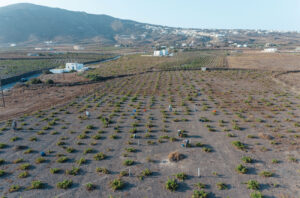
The traditional basket-shaped ‘kouloura’ vineyards of Domaine Sigalas in Santorini. Credit: Domaine Sigalas
The science of adaptation
Producers have responded to the crisis with a mix of vineyard research, water management techniques, and new plantings. At Argyros, that has meant adaptation centres on preserving soil moisture with organic mulching, replanting using cuttings from the healthiest old vines, and conducting irrigation trials on targeted plots.
Assuming that many old vineyards will be non-productive within five years, Vassaltis has taken a different approach. ‘Since 2020 we have uprooted and replanted all our vineyards,’ said Valambous. ‘Our new vineyards are single-variety, trellised and irrigated to combat the warmer weather and lack of rainfall. We use desalinated water, which, although expensive, is the only way to ensure our plants survive.’
At Domaine Sigalas, Boutaris has retained some traditional kouloura while integrating modern irrigation systems. ‘We don’t want to irrigate; we just want to make sure that in the winter, if it doesn’t rain, we will be able to provide the water needed,’ he said.
Beyond individual estates, the Santorini Winemakers Association is working with Aristotle University of Thessaloniki and the municipal water company on a pilot scheme to reuse treated wastewater in vineyards to replace the loss of seasonal rainfall.
For now, however, such projects are driven mainly by producers themselves. Against that backdrop, few hang their hopes on external intervention. Valambous points to limited, bureaucratic subsidies and a clear preference from authorities to back tourism infrastructure over agriculture. Santorini needs to go ‘back to the drawing board’, he said, suggesting there is little room for optimism about coordinated action on the island until that happens.
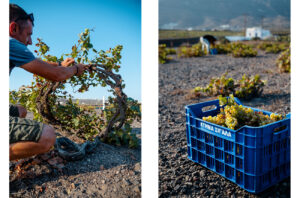
Picking grapes from basket-trained vines in Santorini. Credit: Domaine Sigalas
Growing scarcity
The pressure in the vineyard is already visible in the market. Boutaris says grape prices have ‘skyrocketed’ as yields fall, even as many grape growers leave the sector. Argyros reports a similar trend at his estate, with prices rising steeply over the past decade.
For importers, the consequences are clear. Ted Diamantis, founder of Diamond Wine Importers, says prices for Santorini wines have risen markedly in recent years, while allocations from key estates have been cut by roughly half compared with earlier vintages.
For Greece, the stakes extend beyond one PDO. Today, there are excellent whites produced from Naoussa to Crete, but Santorini remains the country’s global calling card: its most ageworthy white and the label that anchors Greek sections on serious lists. If production continues to contract, Greece risks losing its most recognisable benchmark just as its broader wine scene gains attention.
For drinkers, the picture is more nuanced than one of loss. Santorini is still producing some of Greece’s most compelling whites, and the best bottles remain serious candidates for the cellar. Argyros highlights 2017, 2019 and 2022 as particularly ageworthy, while his top Assyrtiko cuvées and Vinsanto are explicitly built for long ageing.
At Domaine Sigalas, Boutaris describes 2022 as an exceptional vintage for structure and balance, noting that Kavalieros shows the greatest capacity to age thanks to extended lees contact. Valambous considers all four of Vassaltis’ Assyrtiko bottlings suitable for cellaring, and holds back a portion of Alcyone for a second release after five years in bottle.
In practical terms, now is the moment for Assyrtiko lovers to think seriously about buying wine to cellar. With yields falling and favoured vineyards under pressure, quantities of top Assyrtiko will continue to drop – and prices will only rise.