It’s well established that the wine industry is one of the more challenging businesses in hospitality, food or beverage. Restaurants, wineries and wine shops navigate shifting consumer tastes, razor-thin margins, and stubbornly high failure rates.
Along with long‑standing business pressures around labour, supply chains, licensing and rising costs, 2025 layered on a new set of political and economic threats.
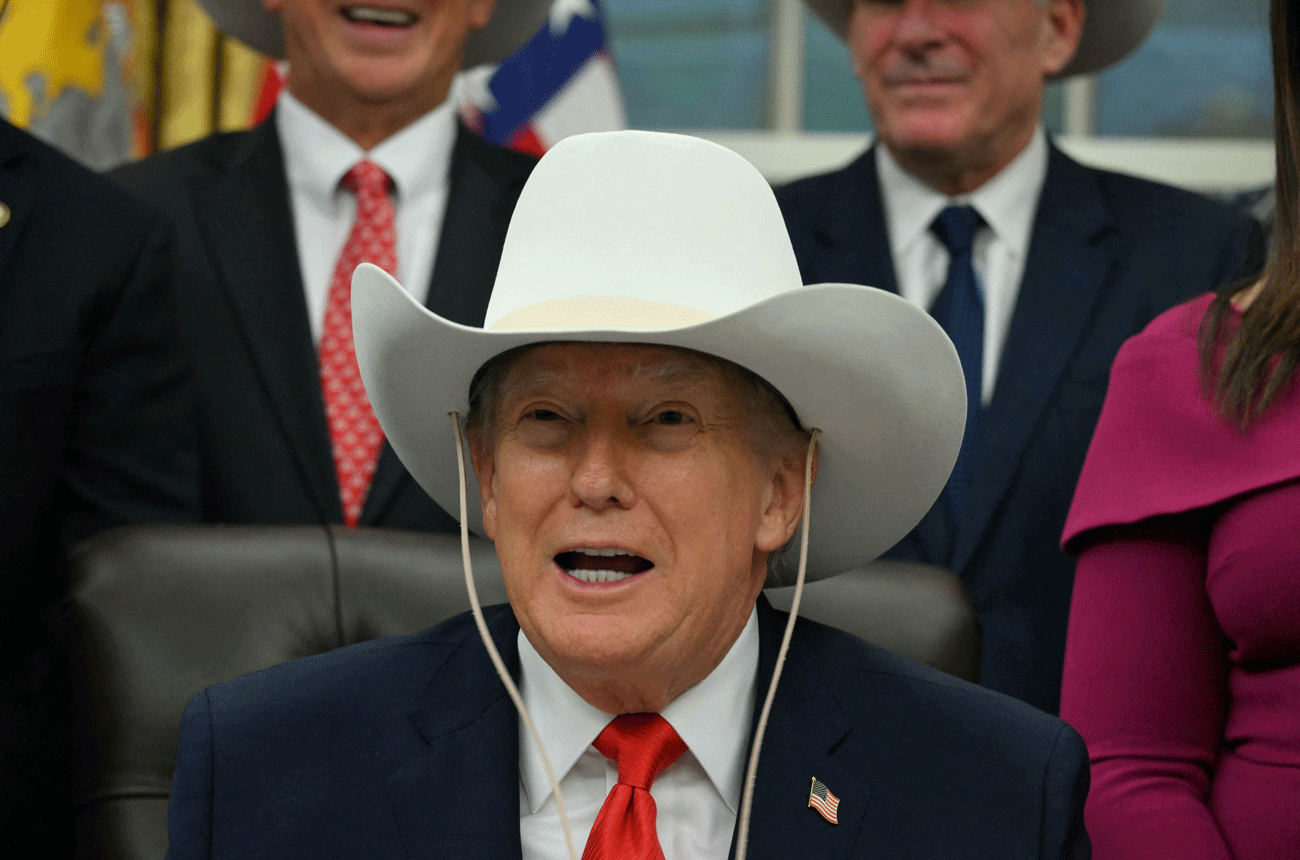
The current presidential administration, led by Donald Trump, has implemented (or threatened) tariffs on key trading partners, with wine squarely in the crosshairs.
European producers now face a 15% US tariff on wine, while broader measures target a wide range of food and beverage imports, from pasta and cheese to items like glass and cans.
At the same time, pointed rhetoric about crime and immigration has been part of stepped‑up enforcement in certain cities, with deployments of Immigration and Customs Enforcement (ICE) and, in some cases, the National Guard.
These moves may seem like political theatre, but in dining rooms and tasting rooms, they translate into anxiety for staff and guests, and a heightened sense of risk for everyone.
Whether these policies ultimately deliver on their goals is beyond the scope of this story.
In March, as part of his ‘Liberation Day’ rollout, President Trump threatened tariffs as high as 30% on key wine‑producing regions, before settling on 15% in the summer.
Trump’s early threats added to already complicated buying decisions and injected uncertainty into an industry that depends on long‑term planning.
The result is a wine industry that feels more fragile than ever. At least according to what you read.
Credit: Jim Watson / AFP via Getty Images
The view from the news
Both perceived and real, the immediate impact of America’s new political climate was felt early by the wine industry.
Over the summer Oregon’s Willamette Valley endured the abrupt detention of vineyard manager Moises Sotelo by immigration agents on his way to work.
Around the same time, the Los Angeles Times covered increasing concerns about immigrant worker safety when ICE raids began. The story featured Lasita, a natural wine-focused restaurant, which saw a 95% drop in reservations after protests forced Mayor Karen Bass to institute a curfew.
In Washington, DC, a survey by the Restaurant Association of Metropolitan Washington found that 73% of respondents cited federal workforce layoffs, and 68% cited the impact of immigration policies on staffing as major concerns. And 44% of full‑service casual operators said they may be forced to close this year.
The immediate effects were hard to miss. Tensions, raids, and headline‑grabbing policy shifts darkened the outlook for businesses already operating with razor-thin margins.
Yet conversations with owners and workers reveal a more layered story. One that cuts past political soundbites and headlines and shows how, and if, these pressures are actually reshaping dining rooms, tasting rooms, and wine shops.

Credit: Thomas Barwick / Stone via Getty Images
The reality on the ground
For some, these developments feel like a distant reality, while those in places like the Willamette Valley, Los Angeles, Washington, DC, are encountering them directly.
Running a wine business is a balancing act, on both the retail and restaurant side, even before politics enters the picture.
Beyond basic supply and demand, professionals manage a perishable, expensive product subject to the whims of weather and shifting tastes. But when political forces interfere with daily operations, the impact is far more complex than a simple fluctuation in sales.
Washington, DC, is one of the epicentres of this tension. The city has faced a convergence of pressures from tariffs and ICE raids, to the unprecedented deployment of National Guard troops.
‘In a city with a diverse group of employees, people became more worried about coming into work,’ said Jen Anderson, founder of Novella Wines.
This anxiety was compounded by the longest government shutdown in US history. A total of 43 days that limited cash flow in a city reliant on federal business.
As a result, high-profile closures like one-Michelin-star Tail Up Goat and wine shop The Urban Grape fuelled a grim narrative, but not everyone blames politics.
Jess Outer, owner of Unwined in Alexandria, acknowledges the shutdown caused a ‘down tick’ in visitors but remains sceptical of politics as a primary driver of long-term business challenges.
‘The narrative has gotten out of control,’ she said. ‘I don’t think these [closures] have to do with the government; I think it has to do with broader business decisions.’
On the West Coast, Joseph Shaughnessy, a sommelier at Southern Oregon’s MÄS and former US Army aviator, views this as political theatre. He believes the national guard deployments are purely for publicity’s sake.
‘That’s exactly what all this is. They’re not actually doing much,’ he said. But he also urges the industry to look past the current administration. ‘But, there will be a day when this administration is no longer in charge. Longterm, we can’t lose sight of larger issues like climate change and generational shifts.’
In Los Angeles, restaurants and bars are seeing customers with increased tension on their faces and in their wallets. But that hasn’t stopped sommeliers and restaurant staff from doing what they do best.
‘In April of this year, when tariffs were first raised, that was when I first noticed guests seemed anxious about what they were spending. Regulars normally in the $300 to $500 range per bottle, were suddenly asking for recommendations under $200,’ said Briana O’Connor, former sommelier at upscale Italian restaurant Marea in Beverly Hills and wine consultant for Lokey Wine.
‘The restaurant business is always challenging,’ O’Connor continued. ‘The political climate just adds extra stress to that, but hospitality professionals are never going to stop doing what we love, which is taking care of people, especially during these trying times.’

Credit: Aaron Schwartz / Bloomberg via Getty Images
Navigating turbulent times
The political issues of 2025 have undeniably reshaped the landscape. But for most operators, these aren’t singular game-changers, but layers added to an already heavy load.
This era represents yet another headwind in a notoriously demanding industry. For struggling businesses, it can accelerate decline. For others, it forces adaptation: tighter operations, evolved offerings and a deeper reliance on loyal customers.
‘I don’t think it’s just doom and gloom for the sector,’ said Anderson. ‘It’s certainly a challenging time, but DC is resilient.’ Outer agrees, emphasising the lifeline of local support: ‘Our community sticks with us no matter what. It’s everything.’
Closures are rarely the result of a single factor. Political turbulence matters, but it isn’t the whole story. It is simply the latest chapter in an industry defined by its ability to absorb the shock waves, evolve and keep pouring.